Proactively plan network investment where it’s most needed
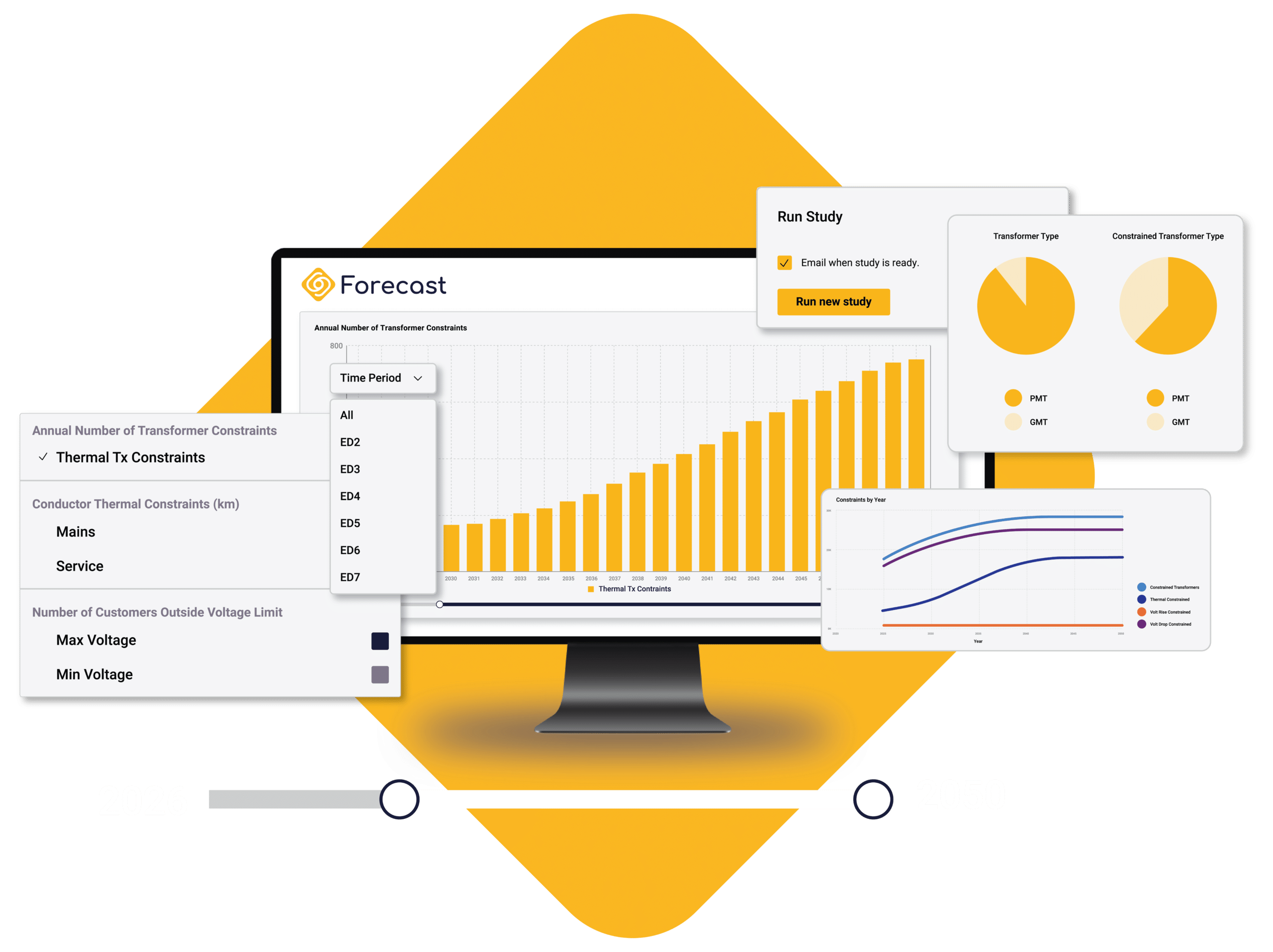
VisNet Forecast lets you accurately anticipate where network improvements are most vital. Instead of months of engineering effort, VisNet Forecast allows you to run scenarios in a few hours, unlocking rapid, repeatable investment planning.
Identify constraints early and plan with confidence
VisNet Forecast helps you run studies faster, target investment more effectively, and back decisions with clear, auditable evidence. It brings speed, precision and confidence to every stage of network planning.
Supercharge workforce bandwidth
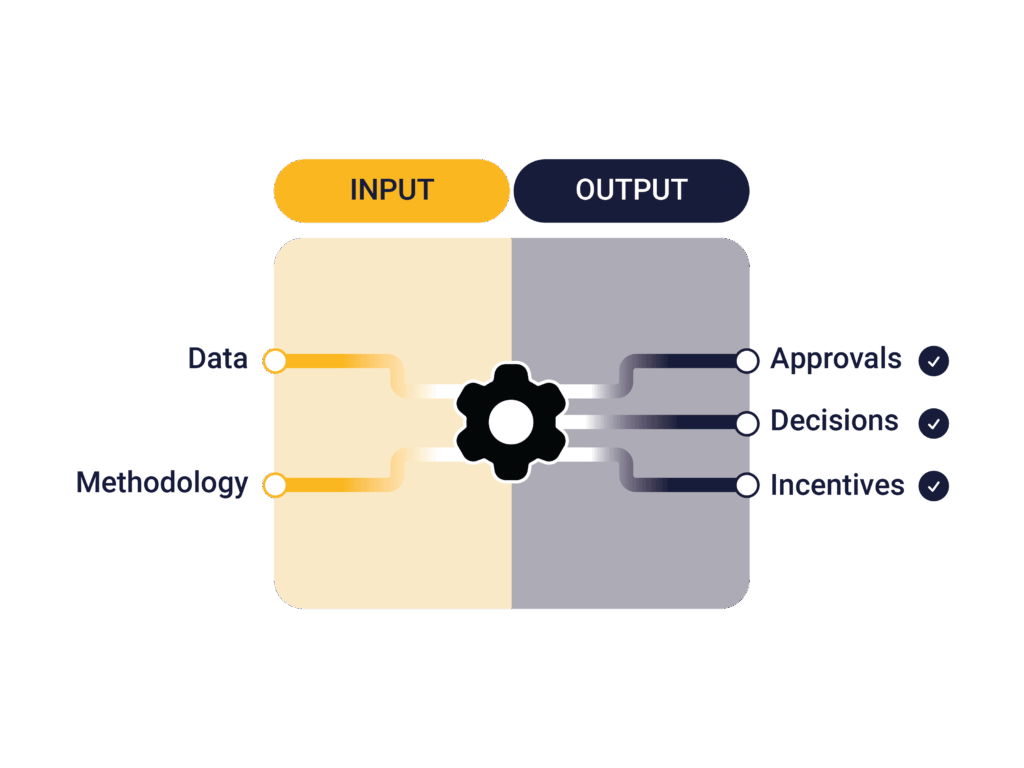
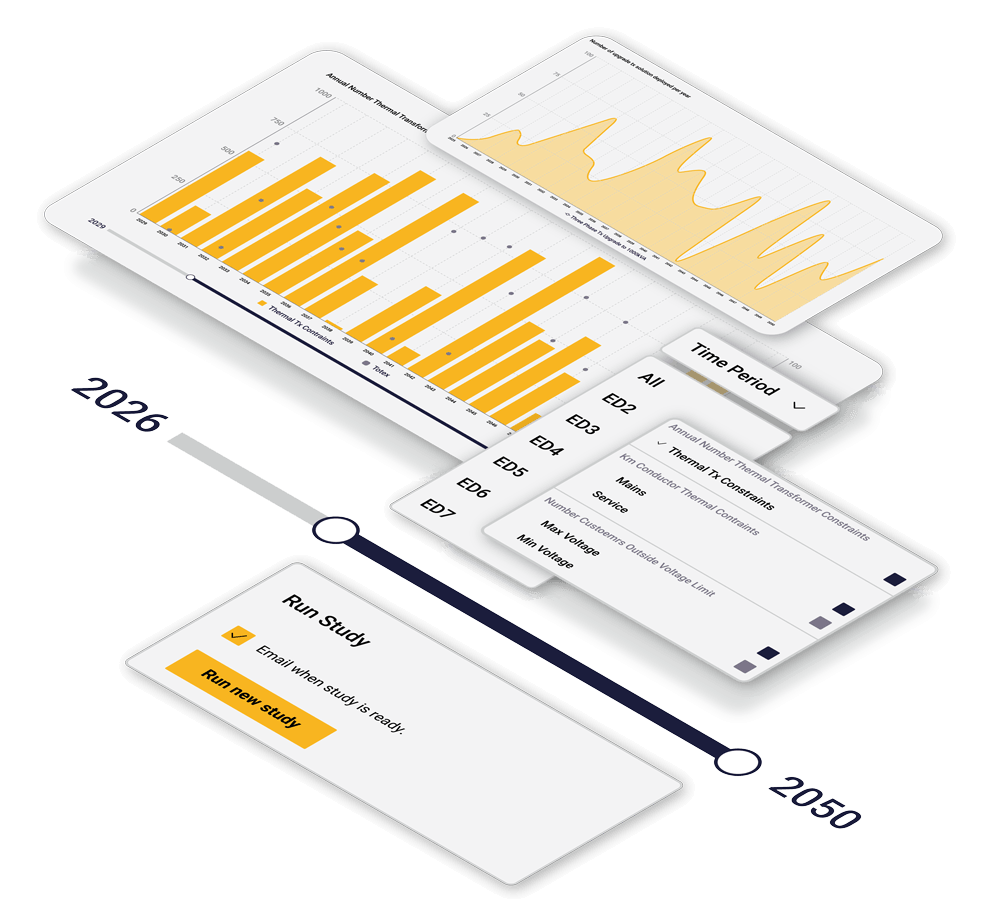
Built on a static digital twin of the network, studies can be run in record time, and re-run each year with updated network data without the need for large engineering support.
Investment where it matters
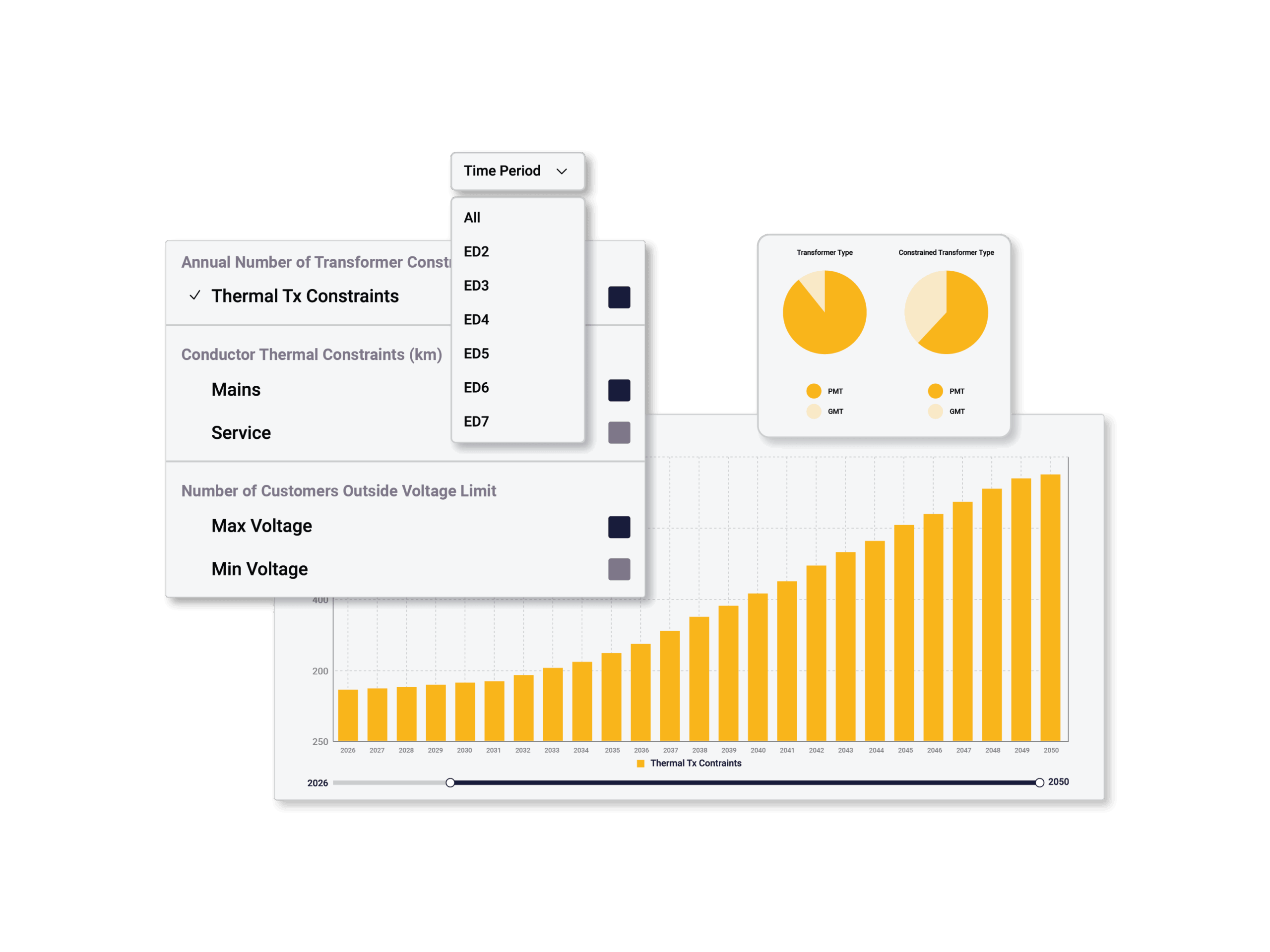
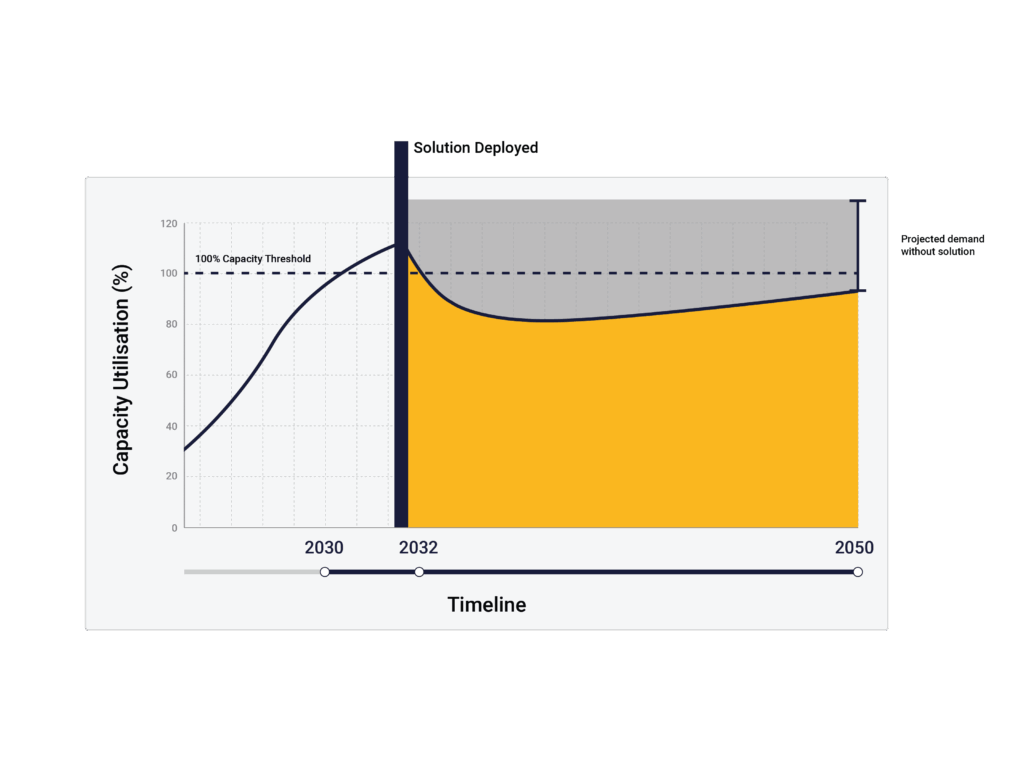
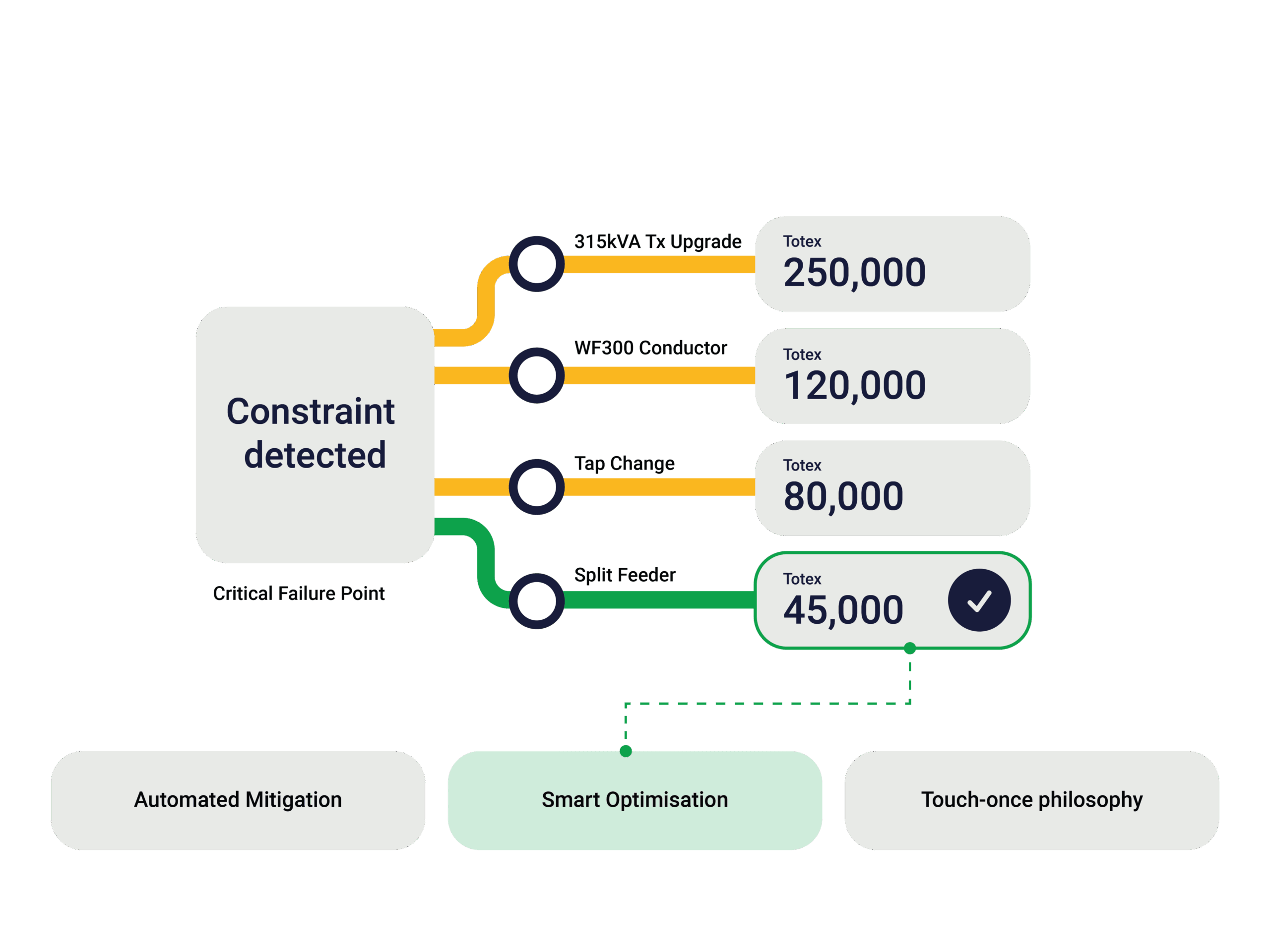
Yearly constraint analysis of every feeder and transformer gives clarity on when to invest, not just where, so spending is focused on what could break first.
Evidence-based planning
Quantified, validated studies move investment decisions from reactive to proactive, and provides the evidence regulators require to back reinforcement business cases.
Forecast with foresight
As demand on the grid intensifies and scrutiny of investment decisions grows, proactive, evidence-based reinforcement planning is critical.
VisNet Forecast produces accurate scenarios of future constraints, identifying the most vital investment requirements without significant engineering effort.

Company Type:
Distribution Network Operator
Industry
Energy/Electrical Networks

VisNet Forecast is now our primary source for ED3 planning, helping us understand network constraints at scale and build confidence in our investment requirements.”
Eloise Thatcher
Lead Design Engineer, Northern Powergrid
Did you know?
5x
Increase LV targeting accuracy by 5x by utilising real network data
2030
to
2050
Plan for both medium and long term investments with scenarios as soon as 5 years from now, to 2050
50%
VisNet Forecast outputs support up to 50% of a network operators LV business plan
MONTHS
to
HOURS
Reduce repeatable planning studies from months of manual effort to hours, enabling faster scenario testing
Do you feel prepared for the future of demand of your network?
See how VisNet tools help low and medium voltage network owners and operators prepare for the future.

Frequently Asked Questions
Product Overview & Differentiation
What is VisNet Forecast?
VisNet Forecast is EA Technology’s network investment forecasting software. It models the impact of distributed energy resources (DERs), including electric vehicles, heat pumps, solar PV, and battery storage, on low voltage electricity networks.
The platform identifies where and when infrastructure constraints will occur, evaluates suitable reinforcement strategies, and produces detailed investment forecasts to support forward planning.
VisNet Forecast is designed for global application. It supports region-specific network data, DER uptake forecasts, and configurable engineering parameters, enabling it to be adapted for use across different countries and regulatory environments.
What is the difference between VisNet Forecast and Transform?
Transform takes a top-down, parametric approach: it uses representative network archetypes and statistical cost functions to estimate aggregate reinforcement needs. It works well at HV and LV level and does not require detailed connectivity data.
VisNet Forecast takes a bottom-up, physics-based approach: it models the actual LV network topology, runs a full electrical load flow on every asset, identifies specific constraints per asset per year, and automatically selects optimal reinforcement solutions. It requires detailed LV connectivity data from ConnectStore.
Transform tells you how much investment you are likely to need across the network in total. VisNet Forecast tells you exactly which assets will fail, when, and what the cheapest fix is.
What problem does VisNet Forecast solve?
Electricity networks are experiencing increasing strain due to the rapid uptake of distributed energy resources. Network operators need to understand which assets will become constrained, when constraints will occur, and the associated cost of intervention.
Traditionally, this analysis requires significant manual effort across multiple teams and can take several months. VisNet Forecast automates this process, enabling full-network studies to be completed in significantly reduced timeframes.
Modelling Methodology & Simulation Engine
How does VisNet Forecast assess network performance?
VisNet Forecast uses the DEBUT engine, a deterministic, physics-based load flow engine that models the full low voltage network.
For each study year, the model evaluates 48 half-hourly intervals across key seasonal conditions, including winter peak demand and summer peak generation. It identifies thermal overloads, voltage limit violations, and phase-to-neutral loop impedance (PNLI) exceedances.
What types of network constraints can VisNet Forecast identify?
VisNet Forecast identifies multiple constraint types within a single simulation, including:
- Thermal transformer overload
- Thermal conductor overload
- Voltage drop
- Voltage rise
- Phase-to-neutral loop impedance (PNLI) exceedance
How does the VisNet Forecast solution engine work?
Once constraints are identified, the solution engine selects an appropriate combination of reinforcement interventions to resolve them.
Available interventions include transformer upgrades, new installations, conductor upgrades, feeder splitting, tap changes, and load transfers. The network is re-simulated after each intervention to confirm technical effectiveness and assess cost.
Data Inputs, Quality & Requirements
What data inputs are required to run VisNet Forecast?
VisNet Forecast requires three primary inputs:
- Network data, including topology, assets, and customer connections
- DER uptake forecasts describing future deployment of technologies
- Solution cost data, including capex and opex values for reinforcement options
How does VisNet Forecast handle low-quality or incomplete network data?
VisNet Forecast is designed to operate with real-world data where completeness may vary.
By running physics-based simulations, the platform can highlight gaps, missing assets, and inconsistencies in the network model, helping users improve data quality over time.
Scenario Analysis, Outputs & Results
What outputs does VisNet Forecast produce?
VisNet Forecast provides a range of outputs, including:
- Constraint reports detailing affected assets and timing
- Solution reports outlining selected interventions and associated costs
- Financial forecasts showing annual and cumulative investment requirements
- Interactive maps visualising network constraints geographically
- Charts and trend analysis of constraints and expenditure over time
- Data exports for further analysis in tools such as Excel or Power BI
Can VisNet Forecast compare different future scenarios?
Yes. Multiple DER uptake scenarios can be run and compared to assess the impact of different planning assumptions.
Individual technologies can be modelled independently or in combination, and key engineering and financial parameters can be configured to support sensitivity analysis.
Decision Support, Regulatory Alignment & ROI
Can VisNet Forecast support regulatory business plan submissions?
Yes. VisNet Forecast produces detailed, asset-level evidence of network constraints and investment needs, supporting regulatory submissions.
Outputs can be aligned to regulatory periods and re-run with updated data to ensure investment cases remain current and defensible.
What is the return on investment for VisNet Forecast?
VisNet Forecast significantly reduces the time required to complete network studies, enabling results to be generated in hours rather than months.
By identifying where and when intervention is required, it supports more targeted investment, helping to avoid unnecessary spend and ensuring resources are directed to the highest-priority areas.
The platform enhances existing planning processes, with outputs feeding into business planning, reporting tools, and downstream design activities.
Access, Security & Deployment
How is VisNet Forecast accessed and secured?
VisNet Forecast is a cloud-hosted web application accessed through a standard browser, with no local installation required.
Security features include Single Sign-On (SSO), Multi-Factor Authentication (MFA), IP address restrictions, and role-based access control. The platform is hosted on Microsoft Azure with resilient, multi-zone infrastructure.
It supports multiple concurrent users, with studies processed sequentially to ensure consistent and accurate results.
How do organisations get started with VisNet Forecast?
Implementation typically includes data assessment, data integration, and platform configuration, followed by user training.
Pilot studies can be run on a subset of the network to demonstrate value before full deployment. Demonstrations are also available using representative scenarios tailored to the network operator.
Other VisNet software solutions
Ensure your network is future-ready with our range of scenario modelling, connections and design modelling

VisNet® Design
Design and model Low Voltage (LV) electrical networks efficiently with VisNet® Design software. Quickly assess new connections for safety and cost.

VisNet® Connect
Optimise connection estimate and full offer applications with VisNet Connect, available for both Low and Medium Voltages.
Sign up to our newsletter
Learn more about our market-leading products and how we’re supporting the world’s transition to decarbonisation.
Case studies
Find out how we have helped clients develop and deploy scalable solutions.